Your prescription register shouldn't be a separate job
Every hospital pharmacy in India is legally required to maintain a prescription register under the Drugs & Cosmetics Act. Most do it by hand, every day, after the billing is already done. There's a better way.
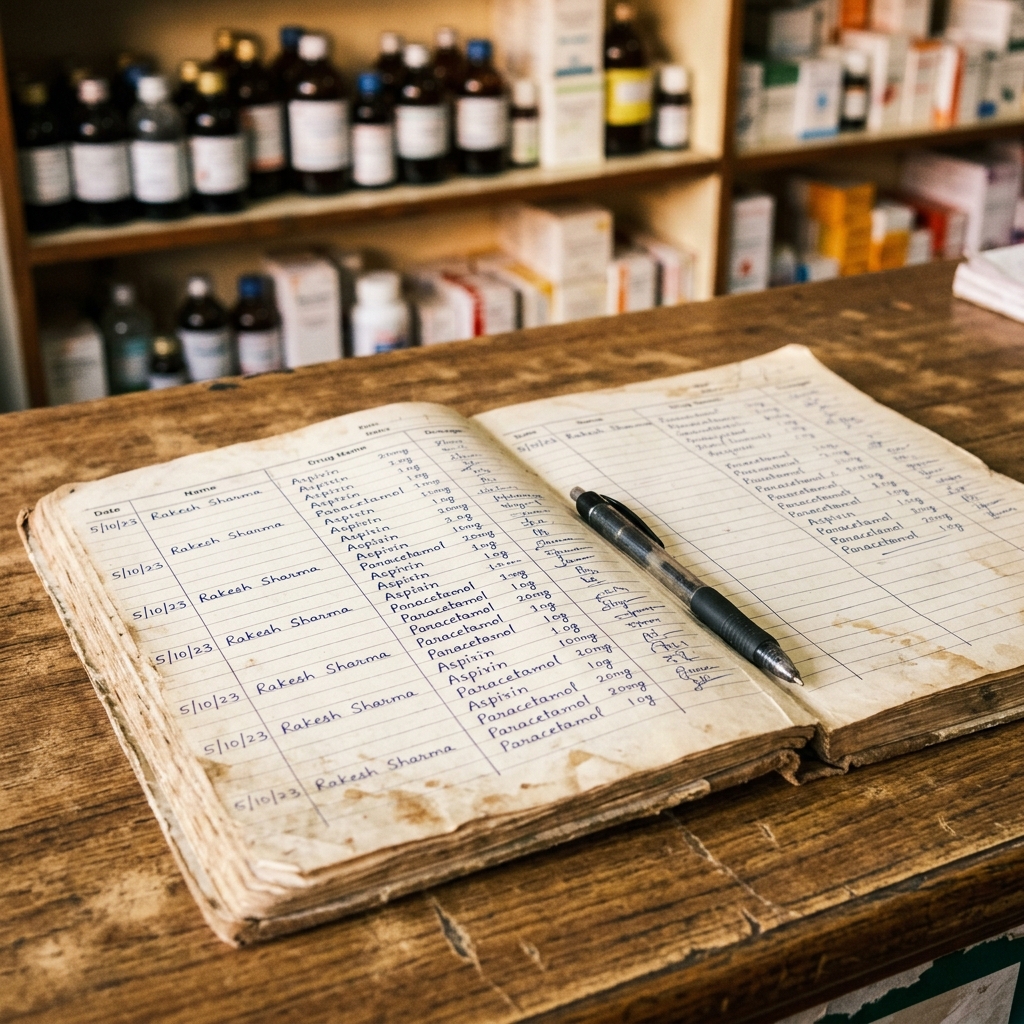
"He billed the patient. Then he picked up the pen. Wrote the same information again — patient, drug, batch, date — into a second book. That's double entry. Every controlled substance. Every day."
The register that nobody designed software around.
If your pharmacy dispenses Schedule H or Schedule H1 drugs — and if you're running a hospital pharmacy, you almost certainly do — you are legally required to maintain a prescription register under the Drugs and Cosmetics Act, 1940.
This register records the patient name, doctor name, drug name, batch number, quantity dispensed, and the prescription date. For Schedule H1 drugs, there's an additional layer. The register is subject to inspection. If it's incomplete or inconsistent with your billing records, you have a problem.
Most pharmacies we visited maintained this register entirely by hand.
Not because they wanted to. Because no software they'd tried had ever thought to include it.
You're already recording this information. Just not in a way that counts.
Here's the thing. When a pharmacist bills a patient for a controlled drug, every piece of information required by the register is already in the transaction. The patient is named. The doctor is referenced. The drug, batch, and quantity are selected. The date is automatic.
All of that information exists in the billing screen at the moment of sale.
Then the pharmacist closes the bill. Turns to the register. Picks up the pen. And writes it all down again.
That's not a compliance step. That's a copy-paste task that software should handle.
The register writes itself. In the same database transaction as the bill.
In WeDose, when a bill is saved that includes a Schedule H or H1 drug, the prescription register entry is written automatically — in the same operation, at the same moment. There's no separate step. There's no second screen. There's nothing for the pharmacist to remember.
The register is always current. It's always consistent with the billing records, because it's derived from them. When an inspector asks to see it, it's a download — not a reconstruction.
For Schedule H1 drugs, the billing screen shows a warning banner at the line level. The pharmacist confirms the physical prescription was presented. That confirmation is logged. The entry is complete.
The pharmacist still does their job at the counter. They just don't do it twice.
- Schedule H and H1 flags are built into the medicine master — preloaded for all ~30,000 SKUs in the database, no manual tagging required.
- The register entry is created in the same database transaction as the bill — they can never fall out of sync.
- H1 drug dispensing requires explicit confirmation that a physical prescription was presented, logged against the user and timestamp.
- The register is exportable in a format suitable for inspection — not a raw database dump, but a properly formatted document.
Compliance shouldn't be a chore. It should be a byproduct.
This is how we think about all the compliance requirements in hospital pharmacy work. Not as extra tasks to be scheduled and dreaded. As things that should happen automatically, quietly, as a direct consequence of the work you're already doing.
The prescription register is the clearest example. You bill the patient. The register is written. You didn't do anything extra. The compliance is just there.
The same logic applies to GSTR-1 exports, audit logs, and expiry tracking. Every one of them is a byproduct of normal daily work — not a separate job that has to be squeezed into a Saturday afternoon.
Filing day is just another Friday.
You're already doing the work. You shouldn't have to do it twice.
If you run a hospital pharmacy and you're still filling the prescription register by hand, we'd like to show you what your month-end looks like when that chore disappears.